


An Analysis of Imperialism in Joseph Conrad's Heart of Darkness
- Deconstructing English

- Nov 16, 2020
- 13 min read
Heart of Darkness (Conrad, 1994) is a story inspired by its author’s own life. In a way, it could be considered Joseph Conrad’s autobiography, since his experiences as a sailor were used as the foundation for this tale. His younger self saw Africa as an uncharted and mysterious territory, which is probably related to the conception of the world Europeans used to have. Researcher Cedric Watts calls it “an era of intense international rivalry for colonial possessions” (Stape, 1996, pp. 45, 46), including the rich and vast African territories. The vigorous crusade to gain more domains than other nations was so intense that even the literature of the 19th century reflected it. Adventure narratives romanticised the exploration of the world, and Heart of Darkness is, in a way, derived from those daring and heroic quests. Therefore, what this paper intends to show is how imperialism is exemplified and its methods exposed in this Conradian tale. In spite of the allegations other writers have made regarding Conrad’s allegiances, the text shows that his experiences in the Congo predisposed him to be in disagreement with those colonialist practices.
The Scramble for Africa and Conrad’s Youth
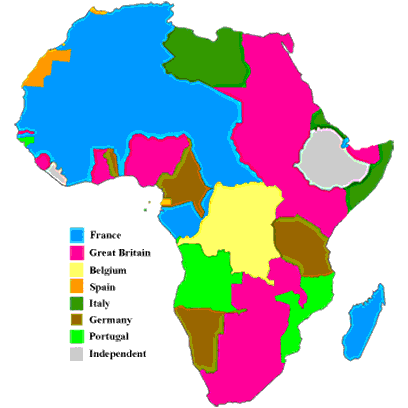
The practice of imperialism was especially in force during 1880-1914. During that time, the world was split between the most powerful modern nations of the world. The competition to gain more overseas land significantly increased the rush to acquire more international dependencies, which could in turn magnify their wealth and strengthen their armies. Because of its advanced technology and weaponry, Britain became the largest empire ever known when it added Africa to the list of colonies it had its hold on. On the Scramble for Africa, writer Andrea White comments that the Berlin-Congo conference (1884-5) “effectively partitioned Africa among England and thirteen other Western nations” (Stape, 1996, p. 182). Even in Heart of Darkness, the distribution of the world is represented by a map “marked with all the colours of a rainbow” (Conrad, 1994, p. 14), referencing the different countries that had taken possession of most parts of the world.

One of those nations was Belgium, which took hold of the Congo, proclaiming it a ‘Free State’. Far from being free, King Leopold II imposed elevated taxes on the native Congolese, under the pretense of bringing civilization and Christianity to the land. A good portion of the population was enslaved and exploited for the extractions of ivory, and murdered for the benefit of both Leopold and his emissaries. In addition to this, Guy Burrows mentions that, when word reached Europe about the atrocities committed in the Congo, people assumed that it was natural for some African lives to be lost, as their vicious rebellions needed to be quenched, serving as examples for others. After all, “weren't the sentries merely protecting themselves”, against the “sanguinary habits” of those “wretched negroes”? (Murfin, 1996, p. 6). The image of the civilized invader was elevated when compared with That is why in a very ironic manner, the narrator of Heart of Darkness describes a settler as “the gentlest, quietest creature that ever walked on two legs”, who was obliged to “[assert] his self-respect” by “[wacking an] old nigger mercilessly” (Conrad, 1994, p. 13). The way in which the invaders treat the defenseless natives in the story is a clear depiction of history and what Conrad may have seen in Africa.
It is in this ethnocentric context where Joseph Conrad was born. Unlike what may be assumed through the reading of his long-winded texts, he was not an English man. As a matter of fact, he belonged to a short-lived Polish nation that was claimed by Austria, Prussia and Russia when he was still a child. It is believed that his early encounters with Russian imperialism prompted him to be against such extreme practices. Furthermore, his own parents were exiled, suffered and posteriorly died due to their patriotism (Stape, 1996, p. 48).

Soon after, he engaged himself with the British navy, to accomplish his boyish dreams of sailing offshore, to explore those enigmatic lands that had barely been delimited. Africa seems to have intrigued him more than the West Indies, as he changed the English navy for a Belgian ship that could take him to the Congo (Murfin, 1996, p. 7). When comparing his experiences as a sailor with the first pages of Heart of Darkness, it is easy to spot the similarities. Marlow, the second main narrator, also mentions his “passion for maps” (Conrad, 1994, p. 11). What attracted him to Africa was its unfamiliarity. Back then, cartographers illustrated it as “the biggest, the most blank” space in the map. With the passage of the years, it was transformed into “a place of darkness”, through the addition of “rivers, lakes and names” (Conrad, 1994, pp. 11, 12). Perhaps the adventure narratives of the time and the tales of others who had made their wealth in those places inspired the young Conrad to venture into those distant lands (Barrish, 2011, p. 13). Whatever the case, years later he himself mentions that his undertakings in Africa were the inspiration behind his writings. These writings, however, are not entirely true to his background. The way he describes them is “experience pushed a little (and only a very little) beyond the actual facts of the case” (as cited in Poole, 2009 p. 298).
The Discourse of the White Supremacy
Even though he had spent 20 years travelling with the English fleet, it is possible that Conrad had little knowledge of the inhuman treatments of the colonised natives. Most Europeans naively believed the propaganda that colonialist nations disseminated. Andrea White explains how most people assumed there was some type of “‘trade’ or ‘exchange’” that was beneficial to both natives and invaders (Stape, 1996, p. 183). To an extent, they seem to be unaware of what actually took place in those distant areas. His first-hand contact with those quests allowed Conrad a deeper and more complete understanding of the customs that occurred and were hushed in Africa. Such is the case of Marlow as well. Sharing his opinion with fellow British men, he mentions that “The conquest of the earth, which mostly means the taking it away from those who have a different complexion… is not a pretty thing when you look into it too much” (Conrad, 1994, p. 10). As it is seen here, the Marlow who has already spent years navigating with different European nations is aware of the complexities and undertakings of colonialism. A few pages later, he adds that they “run an overseas empire, and make no end of coin by trade” (Conrad, 1994, p. 14). The irony of this passage is understood when one realises that Conrad’s intended reader were in fact the Victorians: those who sincerely or cunningly believed that fair “trade” was being made, when the reality and their country’s wealth demonstrated that they made “no end” to the taking of that wealth. The Europeans were living in what Patrick Brantlinger calls “the Victorian myth of the Dark Continent” (Brantlinger, 1988, p. 173).
In a way, colonising countries were influenced by the Darwinistic ideas that had set foot in their society. As it was assured, Social Darwinism was the scientific explanation they needed in order to explain why some individuals and societies were in better positions than others. In a way, it seems to be unavoidable and natural that wealth and power would be the possession of only a few. Those who dominated the world were assumed to be biologically prepared to be stronger and succeed over others—“the growing concentration of power and wealth in a relatively small elite was not immoral but instead inevitable” (Barrish, 2011, p. 119). Anthropologists would argue that “Civilizations progress much as children develop into adults” (Stape, 1996, p. 186). ‘Less sophisticated’ societies are like impulsive children who need the care and guidance of their parents to survive, but, as they grow up, they learn to be more reflective and independent. This notion is made evident in Heart of Darkness when the African and European people are compared. Other characters of the book stereotype natives as “savages” (Conrad, 1994, p. 27) and “cannibals” (Conrad, 1994, p. 49). And yet, what surprises Marlow the most is that, despite their moribund state, “they were not inhuman… what thrilled you was just the thought of their humanity - like yours - the thought of your remote kinship with this wild and passionate uproar” (Conrad, 1994, p. 51). Marlow calls this feeling a “suspicion”, indicating that probably not most Victorians were entirely convinced of the “kinship” they may have with the African men. Others, like Marlow, accepted such a relation, but they asserted that the connection was remote, just like the bond one may have with animals. Europeans saw themselves as more evolved individuals, capable of greater achievements and thoughts.

In this ‘imaginary’ context, the concept of the settler’s supremacy is imposed upon the natives, who are subdued and whose individuality is repressed. The fact that they were regarded as mere, underdeveloped savages shows that black people were prevented from expressing their subjectivity. Their history is that of absolute suppression, creating a rift that could not be mended in decades. These supremacist ideologies, disguised as scientific truths, opposed nations through the creation of binary oppositions, which in turn marginalised even further those who were oppressed.
A Tale within a Tale and Unreliability
The way in which Heart of Darkness is told is rather significant to understand Conrad’s subtleties. To begin with, even though Marlow is the one who narrates his own experiences, his story is framed within that of another narrator. There are few instances in which the voice of the original narrator appears, but those moments make us aware of the fact that the reader is not learning about the events of the book first-hand. On the contrary, they are the memories of the sailor who heard Marlow’s tale. Such a practice was not rare for British people. Cedric Watts mentions that it was a custom to attend “social gatherings at which travellers would meet to compare notes and exchange yarns about foreign experiences” (Stape, 1996, p. 46). This might remind us that whatever reached the majority of the European citizens was retold by others who had been to other continents. What they decided to convey, however, may not have been utterly reliable. After all, even Marlow admits that when he signed the contract with the Belgians, he “undertook amongst other things not to disclose any trade secrets” (Conrad, 1994, p. 15). Most of the habits of the settlers in those far off continents could by no means be disclosed with the general population, as they were to remain secret.
On the other hand, because the reader is presented with a story within a story, they are not aware of who the real narrator is or what their intentions may be. The lack of an omniscient narrator points out that “we learn about ‘reality’ through other people’s accounts” (Murfin, 1996, p. 15). Perhaps Conrad included this modernist technique to be a means of awakening for his intended readers, who should not always believe in twice-told tales. After all, that supremacy, which apparently granted them the capacity for reason, should also permit them to think for themselves and analyse their circumstances. Perhaps some of them would be able to think outside the limited spectrum of reality that was shown to them.

Truth is that this hegemonic discourse persisted and flourished in the minds of those who were centred. History demonstrates that, in the majority of the cases, the settlers accepted this alterity, separating their Self from the Others. They genuinely believed in the cultural differences and their upper hand, instead of simply trying to understand those who were mistreated and marginalised (Ashcroft, Griffith, & Tiffin, 1995, p. 18). Because of this fixity in which they considered black people as sheer animals, the story describes a vivid picture of that inhumane behaviour. As he goes through the Congo River, Marlow comes across six black natives whose ribs and limbs “were like knots in a rope; each had an iron collar on his neck… connected together with a chain whose bights swung between them” (Conrad, 1994, p. 22). Not only were they marginalised, they were considered and treated as “criminals”, the starved workforce of those who colonised them.
Joseph Conrad and Ethnocentrism
This manichean opposition is also represented in the way the characters are portrayed. To begin with, no native character is given a voice, their subjectivity is not identified, and their characteristics are barely fleshed out. At the same time, Marlow “resembled an idol” (Conrad, 1994, p. 6). Many a writer has expressed their discontent with the way in which Conrad outlines those native characters. His authorial intention has been discussed over the years, some assuring that Conrad supported white supremacy. No doubt most people were indeed influenced by the hegemonic and racist discourse of that era, and Conrad was probably one of them. Regardless of that, he writes about a character whose view of the African people changes as he travels through the Congo and is confronted with their reality. This may well have been Conrad’s case as well. His experiences in those lands may have reshaped the way in which he deemed the colonial authority.
Those who believe Conrad supported ethnocentrism may be falling into a type of intentional fallacy. Assuming that the author’s intentions when writing his story were to broaden the discrimination and to assert the beliefs of the European socities may be gravely mistaken. After all, he managed to portray realities that were not commonly known and exposed during those days. Peter Nazareth explains it this way: "Jane Austen's characters in Mansfield Park could live a luxurious life while the patriarch left for the colonies; Conrad actually takes us to the colonies to show us what happened there when the patriarch or his agents arrived and how his wealth at home came from brutal colonial action. Conrad was therefore a mental liberator" (Murfin, 1996, p. 110).
Instead of foregrounding his honest opinions, he opted for a craftier and wittier way to divulge what he had seen. His use of paradoxes proved that every civilization, no matter how urbanised and advanced it may be, can be savage in its treatment and marginalisation of others. Even those who appear to be sensible people, moved by reason, can in certain situations be corrupt and abusive (Stape, 1996, p. 47). That depravity and immorality are not at all related to the colour of one’s skin, the place where one is born, or the social status one may have. Marlow describes the attitudes of the colonisers as having “a touch of insanity” at the enterprise of “firing into a continent” (Conrad, 1994, p. 20). Unlike the pledges of King Leopold, the motive behind those excursions were not to help the natives, as parents would guide their child. Far from it, they were simply “Hunters for gold or pursuers of fame… the germs of empires” (Conrad, 1994, p. 7), using the free workforce to find “a precious trickle of ivory” (Conrad, 1994, p. 26). The profit they could gain from it was all they held dear.
Twice in the novel, the reader is presented with a symbolism of the European rule. It is said that settlers “bear the sword, and often the torch” (Conrad, 1994, p. 7) and once again, a blindfolded woman carrying a torch is seen in a sketch. This seems to be a non-dialectical symbol of the colonial entrance into those uncharted territories. As if they were blindfolded, they settle into this land without knowing its people, their customs, beliefs, and conditions. Assuming that they live in darkness, the colonisers portray themselves as the carriers of the light. The sword, however, indicates their real, utilitarian intentions.
What is most interesting about Conrad is that he makes a comparison between the European settlement in other dominions with the Roman control over what would become the British land. Placing Marlow and his companions in the River Thames gave the reader the opportunity to reflect on what their own territories used to be like (Poole, 2009, p. 301). Back then, what would become Britain was considered “the end of the world”, a place of “wilderness… cold, fog, tempests, disease, exile and death” (Conrad, 1994, p. 9). A place where savagery could be found “in the hearts of wild men”. Men who would rob and murder, with the principal aim of conquering the earth (Conrad, 1994, p. 10). The comparison would probably help the readers see their own conquests as mere robbery of those who have a different complexion. Moreover, it might help them reflect on the absurdity of believing that there may be an intrinsic disparity between the African people and themselves.
However, the British was not the only empire to whom Conrad wrote. In his text, he refers to a variety of people from different nationalities who partake in the looting and scramble of this continent. As a symbol of this, he created a character who could embody their evil deeds. “All Europe contributed to the making of Kurtz” (Conrad, 1994, p. 102), which is why his nationality is not entirely clear. In a way, it implies that he is the everyman. Invaders are portrayed in his persona as their wicked actions are burdened upon him. Some writers believe that Conrad was inspired by Milton’s Satan or Marlowe’s Faust (Murfin, 1996, p. 14). Like Satan, for example, Kurtz transforms himself, from being an European emissary who believed in the “brutes” (Conrad, 1994, p. 72), who complied with the regulations of his superiors, to a “leader of an extreme party” whose vile charisma engulfs the natives and elicit them to serve him. In accordance with this, Abdul Janmohamed writes that “the Other’s recognition of him... allow[s] his own identity to become deeply dependent on his position as a master” (Ashcroft, Griffith, & Tiffin, p. 20). It is a narcissistic view of himself that needs their subjugated people to recognise his authority, which, in turn, feeds his conception of himself and entices his dissolute practices. Comparing Kurtz imagery with the invaders, it is easier to sense the need of those settler’s to impose their rule over others with the main purpose of recognising themselves as superior, while diminishing others.
This does not mean that, unlike Kurtz, Marlow’s attitude towards the natives reflects his understanding or appreciation of them. Marlow also appears to be flawed in his admiration for Kurtz and his dominion over others, as well as his indifferent and dispassionate stance towards those who were clearly suffering. Perhaps Conrad intended this to be ironic since Marlow can certainly spot the fault in others and can reflect upon the enterprise that colonialism represents, but he still appears to be unable to contemplate his own actions and act upon them.
Conclusion
In conclusion, one can reflect that, no matter how oblivious Marlow may be of his tepid viewpoint, he is still more aware of the circumstances than his counterparts. This might be Conrad’s way of reflecting on his own awareness and what he could do to help his contemporaries awaken from their hegemonic slumber. As it was seen throughout this paper, in spite of the allegations that Conrad may have been a supporter of the imperial rule, his writings show otherwise. From a young age, he was exposed to the barbarities of monarchical colonialism, which may have predisposed him negatively towards it.
His inclination and drive for the exploration of faraway lands drew him to experience life in the Congo. And his encounters with the natives and their invaders compelled him to write about what he had seen. The realisation that most of his contemporaries were blinded to the viciousness of their empire may have enforced his will to expose what was occurring in those territories most people did not have access to.
The result was a novella that satirically portrays life from the point of view of a character who represents Conrad himself. In certain ways, Marlow is more awakened than his contemporaries and helps them ponder about how noble the motives may be. At times, he mentions that profit is what drives them, compelling them to subdue and manipulate those who were seen as unevolved creatures. But, in other instances, Marlow represents the majority of the people whose indifference to colonial rule made possible that it continued for years afterwards. Through the accounting of these tales and the exposure of what took place in the colonies, Conrad invites the reader to reflect upon the suffering of those who stood at the foundation of the Empire.
References
Ashcroft, B., Griffith, G., & Tiffin, H. (Eds.). (1995). The Post-Colonial Studies Reader.
London: Routledge.
Barrish, P. (2011). The Cambridge Introduction to American Literary Realism. New York, New
York: Cambridge University Press.
Conrad, J. (1994). Heart of Darkness. London: Penguin Books.
MacDuffie, A. (2018). Charles Darwin and the Victorian Pre-History of Climate Denial.
Indiana University Press, 60(4), 543-564. doi:10.2979/victorianstudies.60.4.02
Murfin, R. (Ed.). (1996). Heart of Darkness: Complete Authoritative Text with Biographical
and Historical Contexts, Critical History, and Essays from Five Contemporary Critical Perspectives (2nd ed.). New York, New York: Palgrave Macmillan. doi:10.1007/978
1-137-05227-8
Poole, A. (Ed.). (2009). The Cambridge Companion to the English Novelist. New York, New
York: Cambridge University Press.
Stape, J. H. (Ed.). (1996). The Cambridge Companion to Joseph Conrad. Cambridge:
Cambridge University Press.


Comments