


Kate Chopin's Desiree's Baby and a Brief History of Feminism
- Deconstructing English

- Oct 10, 2020
- 19 min read
Introduction
As one starts reading about feminism, one might notice that the amount of information written on the topic mostly refers to the first and second waves. It is then, no doubt, that the role of women in the house, as well as their reproductive, political and economic rights were starting to be questioned with more acuity than ever before. Nonetheless, it would be a mistake to assume that women before the 20th century did not, in some way, feel preoccupied about women’s role in society. The book called A Glossary of Literary Terms (1999) highlights two previous centuries “of struggle for the recognition of women’s rights and achievements” (Abrams, p. 88). Among those who described women’s circumstances even before the 20th century was the local colourist Kate Chopin. Like others in her field, she opted for the writing of fiction to address the unfair treatment of minorities such as women and people of colour. It is through short stories like Desirée’s Baby (1893) that she could confront people with the social inequalities of her time. Therefore, the intention behind this paper is to analyse Chopin’s acclaimed Desirée’s Baby through the point of view of feminist literary criticism. To do so, however, it is necessary to first summarise the feminist movement, which was essential for the rediscovering and re-reading of Chopin’s texts.
The First Feminist Wave: Virginia Woolf
Virginia Woolf is at the centre stage of the first feminist wave. Jane Goldman refers to her as “the founder of modern feminist criticism” (Plain & Sellers, 2012, p. 9). As mentioned before, there were a number of other women who spoke up, mostly in fiction, about the struggles women went through during those times. There were also a number of modernist writers who took part in the first wave with texts about gender politics, the suffragette, and even what Goldman calls “literary aesthetics”. She points out, though, that only Woolf managed to combine all those topics in a theoretical manifesto.

Woolf’s famous essay A Room of One’s Own (1929) shows the necessity for women to find their place in society, by setting themselves apart from the encapsulated role in which others have put them. Instead of playing the role of the Angel in the House, she imagined a future where women could “cease to be the protected sex”, where they could “take part in all the activities and exertions that were once denied them” (p. 45). She, however, sees the impossibility of counteracting the state of women’s lives when they did not possess nor have access to the material means necessary to realising their dreams. Most of the times, she mentions, women only had a small amount their fathers gave them, which was only enough to buy some clothes. It prevented them from buying literature to cultivate their minds, or to find a place where they could live in separation from their oppressive families (pp. 58, 59). These restrictions hindered them from acquiring their own subjectivity, developing their interests and pursuing careers, like men do.
The historical place for women has most generally been the house, under the patriarchal rule either of their fathers or their husbands. If they were not able to find a husband, they had no choice but to be servants in their brothers’ homes, or to find a job as a governess in someone else’s house. In either case, they were mostly under the rule of a man. The book From Eve to Dawn (2008) explains that “It was considered self-evident that the sexes were different species with different aptitudes” (p. 130). While men were active individuals who had been blessed with intellectual acuity and the capacity to go into the world and make a living for themselves, women had been assigned a more passive and lenient role in the house, since “her judgment was fit only for detail and trivialities. Therefore the role best suited to her, the occupation that most satisfied her dependent nature was... the role of servant” (p. 130). The culturally constructed view of femininity showed that women had a weaker and utterly dependent nature who needed the protection and guidance of men in order to live happier lives.
This is, in part, what Virginia Woolf discussed in A Room of One’s Own. In her own words, so far women have behaved as men’s looking glass, reflecting their image back to them and enlarging it to satisfy their ego (pp. 41, 42). In other words, women have also naturalised that their life role is to maximise the potential of their husbands, while also diminishing their own capacities. They have, then, been part of the construction of that patriarchal system and this is something that is often seen in literature itself. Woolf asserts that, even though womanhood is one of the most approached topics in fiction, its depictions are not reflective of real women. Rather, these representations are penned by men according merely to their cultural constructions and ideals. Once again, Jane Goldman asserts that the term ‘woman’ “is a signifier of patriarchal discourse”, its signification does not correspond with the “lived, historical and material experience of real women” (Plain & Sellers, 2012, p. 75). Woolf says that they have created an image of “an odd monster” that does not actually exist (1929, p. 50).
In this respect, not only did they feel unidentified whenever they read literature about women, they also could not feel connected to the way men wrote. The ideas Woolf presents on a type of syntax suited for women are not thoroughly described in her writings, but they do anticipate the theories on écriture féminine, which would later be delved on by French feminists such as Hélène Cixous. Regardless of what she tried to mean by the term ‘feminine syntax’, it is understood from her text that she was encouraging women to write about themselves. Instead of letting men and society in general define how women were or should be like, they themselves needed to express their opinions and feeling in paper. This, she adds, could only be achieved if women managed to kill the phantom of the Angel in the House that only ascribed them to the domesticity and submissiveness of the Victorian womanhood (Showalter, 1992, p. 207). They needed to break away from the conventions in order to have a mind of their own.
The First Feminine Wave: Simone de Beauvoir

Another highly influential text on feminism and the construction of gender identity is Simone de Beauvoir’s The Second Sex (1949). The writing of this book was motivated by a wish to expose the number of myths that have been delineated around the figure of ‘woman’. These are social myths which have posited women in the procreative and domestic role in order to sustain the disparity when compared with men.
Constance Borde and Sheila Malovany-Chevallier, in their introduction to a 2011 edition of The Second Sex, note that de Beauvoir had been inspired by Levi-Strauss’ ideas on myths as signifying systems that carry cultural meanings. The book A Glossary of Literary Terms describes signifying systems as combinations of signs that are meaningful to “members of a particular culture”. Myths are not identifiably objective facts. Instead, they draw their significance from binary oppositions and relations to other “elements within the cultural system” and they are mastered by the participants of that culture, even though they are most of the times unaware of their existence and influence on their conceptions of life (Abrams, p, 300). In other words, myths on femininity are conceptions that are not innate to women, but are socially constructed. As they operate at every level of culture and since they have been reproduced for centuries, most people have already naturalised them, assuming that they are inherent traits of every woman. For this reason, when comparing men to women, a binary opposition is generated, where one has what the other one lacks.
Instead of recognising each other’s subjectivity as different, yet still equally valuable individuals in their own right, this binary opposition implies a hierarchy. It does not only enclose men and women in a sheer stereotype, it also subordinates women to their husbands and any other man (Bennett & Royle, 2004, p. 152). Simone de Beauvoir distinguishes a few myths that have been considered absolute truths about women, such as women as subordinated to men, following Adam and Eve’s conception where man is understood as a complete being, but woman can only be defined in opposition to man. She is always regarded as the inferior complementary, the Other. Another myth is the fecundity myth which is implanted on girl’s consciousness from a very young age (Beauvoir, 2011, p. 360). It notably features heavily in Desirée’s Baby, as will be elaborated further in this essay. Literature, like other components of culture, has been used as a means of spreading and reproducing those beliefs.
The Second Wave: Anglo-American Feminism
Both Virginia Woolf and Simone de Beauvoir asserted that the lack of possibilities women were given to develop their writing is one of the reasons why there were so few female writers back in those days. Women had not been allowed a room in society to let their talents flourish, nor did they have the means and the time to support themselves as writers (Beauvoir, 2011, pp. 546, 547). However, there were still a good number of female writers who had, despite impoverished circumstances, managed to make writing their profession. In fact, by the early 1900s, the number of women writing sentimental novels had increased so greatly that authors such as Hawthorne worried that readers would be distracted from texts they deemed more worthy (Barrish, 2011, p. 9).

Among the themes women wrote about in their literature one can find depictions of their daily lives, their chores, clothes, food and other descriptions of their circumstances and routines. According to The Cambridge Introduction to American Literary Realism (2011), this “helped lay groundwork for the ‘solidity of specification,’ the ‘truth of detail’ in fiction that late-nineteenth century realists would celebrate as a ‘supreme virtue’ for novels” (p. 19). Among those realist writers who forged a name for themselves was Kate Chopin. Unfortunately, after the publication of The Awakening (1899), she was harshly criticised and forgotten—even her fiction remained out of print (Barrish, pp. 146, 147). Realising the amount of female writers who had faded into obscurity due to criticism or a lack of appreciation from their male counterparts, feminist critics, in the aftermath of the second wave, took it upon themselves to undust them.
This revisionist movement tried not only to recognise some long-forgotten female writers, but also to incorporate them in the traditionally male Western Canon or what F. R. Leavis called the ‘Great Tradition’ (Childs & Fowler, 2009, p. 203). The ‘Anglo-American’ feminist critics, as they are called, regarded literature as a source to learn about women’s lives in previous decades. For this reason, Peter Barry asserts that it is a very traditional way of approaching literature (2019, p. 86). As encouraged by F. R. Leavis, feminist critics focused their attention on close reading and the minute examination of the text (p. 20). However, they also took into consideration the social, historical and political background in which those texts were formed, as well as the authors’ personal circumstances and experiences. Those, they believed, were necessary for the understanding of the text, but most importantly to recognise the hardships female authors went through in order to write and be published.
Prominent feminist critics include Patricia Meyers Spacks with her book The Female Imagination (1975), Ellen Moers’ Literary Women (1976), Elaine Showalter’s A Literature of Their Own (1977), Sandra Gilbert and Susan Gubar’s The Madwoman in the Attic (1979). Most of them discussed novels from English, American and even French writers from the 18th century onwards, amongst whom Jane Austen, the Brontë sisters, George Eliot, Mary Shelley, Emily Dickinson, and Christina Rossetti (Plain & Sellers, 2012, pp. 125-127, 130). This movement actively encouraged women to be resistant, revisionary readers through the acknowledgement of obliterated authors, the decentring of male-focused readings and the recognition of and opposition to the biases and stereotypes women had been lumbered with.
The Second Wave: French Feminism
The Anglo-American critics were not the only ones who stood out during the second feminist wave; another influential type of feminist criticism took place in France. While the Anglo-American critics looked for specific instances in which literature had enforced male domination, French critics pointed towards language in their claim that discourse in general is phallogocentric (Abrams, 1999, p. 92). In response, they based their writings on post-structural readings with hopes of constructing a theory of gender, which is something their English counterparts lacked.
English speaking feminists had been strongly criticised due to their apparent essentialism, even though it was a concept they claimed to reject. Showalter, for example, wrote about a “distinctive feminine mode of experience”, which she denoted by ‘gynocentrism’ (Abrams, p. 91). This, she claimed, is not a reference to any innate quality present in women, but it is still a “collective understanding of what it means to be a woman” (Selden, Widdowson, & Brooker, 2005, p. 128). For those English-speaking critics, women were finally establishing a unified sense of identity. Opposing this, French critics dismissed the idea as patriarchal, constructed and humanistic. For Gill Plain and Susan Sellers, this produced a “paradigm shift” since even the notion of what the term ‘woman’ meant was on the spotlight.
Since society has incorporated and naturalised the male-female dichotomy, which states the existence of two opposite identities, preventing pluralisation, and since this has been understood as a social and cultural construction, it would not be misguided to assume innate characteristics are actually non-existent. Instead, Judith Butler proposes that gender is “performative”, in the sense that people are mostly what they enact, which is in turn shaped by the stereotypes societies have constructed (Abram, p. 93). Structuralist theories would say that “no term or identity has meaning in isolation” (Plain & Sellers, 2012, p. 215). If one tried to define the term ‘woman’, it would not be possible to find a definition in isolation. Every possible definition would need to be related to other words and meanings. It is necessary to relate and distinguish it from other terms. The most common definition for ‘woman’, then, would refer one back to the term ‘man’. ‘Woman’ would, in a way, be what ‘man’ is not, finding it impossible to create a definition that is intrinsic to femininity.
The problem poststructuralist tried to address is what Claire Colebrook calls the impossibility to find a system of differences “that has no centre, ground or origin” (Plain & Sellers, p. 217). In other words, if one tried to define the concept of ‘woman’ it would most probably be the case that one would see ‘man’ as the centre towards which the concept of ‘woman’ gravitates. One would try to differentiate from ‘man’, seeing them as natural opposites. This, poststructuralists say, is a negative differentiation, which settles women in the position of the Other, the negative object, while man is the positive or neuter term, from which the world is defined (Abram, p. 89). From here on, for French critics, women needed their own relationship with language.
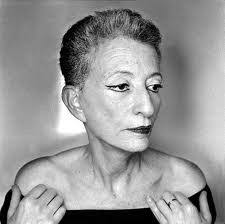



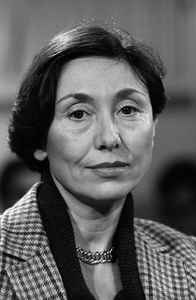
Hélène Cixous is famously recognised for developing the concept of écriture féminine, which is described as pre-linguistic and unconscious as it is based on the relationship between mother and child “before the child acquires the male-centred verbal language” (Abrams, p. 92). The way in which it is produced is through the ‘writing of the body’, the liberation from the limits and restrictions of phallogocentrism and its focus on ‘writing the mind and the world’ by focusing on facts, logic and scientific knowledge. Setting itself apart from this, women’s writing expresses their subjectivity by feminine syntax, which reminds us of the type Virginia Woolf wanted women to find. Cixous would say that “It is impossible to define a feminine practice of writing… for this practice can never be theorized, enclosed, coded” (Barry, 2019, p. 88). This should not let us assume that Cixous refers only to biological women. Any “peripheral figure” should be able to use it if they break away from the onto-theological humanism of male syntax.
Luce Irigaray also calls readers’ attention to the “devaluing of the maternal”, the “matricide” which submerges people into a ‘monosexual economy’, where the masculine word takes prevalence and represses the pre-linguistic relation between mother and child. Therefore, as Judith Still explains it, “the relationship between subject and object takes precedence over the relationship between two subjects”, which only serves the patriarchal oppression and repression of women (Plain & Sellers, p. 268). Julia Kristeva calls this pre-linguistic process “semiotic”, which is subdued when the child learns the “father-controlled, syntactically ordered, and logical language” she calls “symbolic” (Abrams, p. 93). In her view and following the ideas posited by Cixous, literature can be used as a means to break away with those conventions. Writing the body should be a tool to displace man from the centre stage of “authoritarian subject” while also recuperating the subjectivity women have been deprived of.
Writing in the Times of Kate Chopin

As mentioned before, even though the first wave of feminism began in the early 20th century, that was not the beginning of the fight for women’s rights. Other people before them had spoken for women in order to show the oppression they were put through in their daily lives. One of those women was American author Kate Chopin. As a local colourist and realist author, she tried to depict the daily lives of American families living in the Southern United States.
Writing about women had not been pursued only by women themselves. Virginia Woolf mentions that women were “the most discussed animal in the universe” (1929, p. 31) since even men would describe them and write for and about them. In fact, their writings were held in higher regard, compared to those of women writing about themselves. Being a man granted them a “degree of critical detachment”, which women writers would struggle to possess (Bercovitch, 2005, p. 158). Women writers, on the other hand—especially those who wrote and were successful with sentimental literature—were seen as “cheaply manipulative, shallow, and dangerously out of control” (Barrish, 2011, p. 17). Once again, women were being marked out as the negative reflection of the male writer. They would never be as good as men. None of them could manage to reach canonicity as this was traditionally dominated by men. The type of literature they wrote was deemed as lower-ranking, “manipulative”, an exaggeration of feelings that would only numb readers from choosing higher quality texts. This did not mean that male authors excluded sentimental narratives from their writings when they needed to provoke strong responses in their readers (p. 42). But they still criticised those women who used those tools in their texts.
In fact, their refusal of most sorts of sentimental writing was so evocative that they felt the need to turn towards a literary movement that would minutely reflect the facts of everyday life. This is how realism took shape in the writings of the late 19th century. Accordingly, some female writers decided to approach their creative writings through the lenses of the time, using the realist techniques to depict the society they lived in. Most of the time, they dealt with descriptions of women’s daily lives, which were disregarded, or even unknown to men. Their exploration led them to describe and, in a way, shape the conception of the New Woman, “women who did not fit the mould of traditional expectations of their gender” (p. 136). Edna Pontellier would probably fit that description. However, that is most certainly not the case with Desirée.
Desirée’s Baby: a feminist literary analysis

Unlike Edna Pontellier who manages to identify the patriarchal oppression imposed on her, Desirée does not do so. On the contrary, Chopin uses her as a stereotypical and perhaps even ironical example of the Angel in the House. As Avril Horner explains, Chopin, in her series of stories, has touched on a number of myths regarding women that have helped her address issues she may not have been content with (Beer, 2008, pp. 10, 11). In this case, she opts for a personification of the orthodox Victorian woman, who is submissive to the will and wishes of her husband.
Even from a young age, Desirée is described as “beautiful and gentle, affectionate and sincere” (Chopin, 2012, p. 151), qualities that were considered indispensable for women who wished to marry well. Beautiful women had an advantage since the female body was “an object of aesthetic contemplation” for men (Bennett & Royle, 2004). Being gentle, however, assured possible candidates that they would not rebel against their patriarchal rule. Desirée most certainly did not, even when she realised that her husband beat his slaves till the point where “they had forgotten how to be gay” (Chopin, p. 152). Nor did she even defy his authority when he accused her of being black and asked her to leave his house. This is because she had been raised with society’s biased conception that men were superior beings. If the baby was black, it was surely a trait he had got from the mother, whose origins were unknown. In this construction, the hierarchical duality between men and women is emphasised. While women were expected to be meek and gentle, men possessed the cultural authority to mistreat their wives and those whom they considered their objects. Just as any other servant in the house, wives were also a mere property to be used and discarded at will.
So intense was her oppression that even his frown would make her tremble (p. 153) and yet, it was also internalised and naturalised that she still felt love and even thanked God whenever he showed his smile. This was a subordinating view on life that Desirée would probably pass on to her daughter, were she to have any. In fact, she feels alleviated when she realises that she has born a son “to bear his name” (p. 153). A son would be able to carry on his duties as the master of the house, just like Armand Aubigny had done so after the death of his father. He would take over the plantation, own the slaves and continue the line of Aubigny men, “one of the oldest and proudest [names] in Louisiana” (p. 151). A daughter, on the other hand, would only have the expectations of getting married into a family with as high a reputation and wealth as those of the Aubigny. Even if she had no brother to keep the plantation for himself, she would not only lose her family name, but also most of her riches to any suitable prospect she could encounter. For that reason, sons were, once again, preferred over daughters and it was the wife’s role to provide one for her husband. In other words, marriage and motherhood were both seen and treated as institutions rather than representations of filial love.
The binary opposition between men and women was also shown in what the American Law allowed them to do. The story strongly suggests that, Armand pays visits to at least one of her slaves even after having been married and during the time when his wife is recovering from childbirth. Regardless of the passion and fierce love he felt for his wife before marrying, he still paid visits to La Blanche’s cabin (p. 152) and probably even had unrecognised children with her, who were also born into slavery (p. 153). As The Cambridge Companion to Kate Chopin explains, mixed-raced relationships and the “sexual exploitation of female slaves” was a reality in the American South. As it continues to mention, the fact that Chopin as “the daughter of slave-owners” would expose the perverse acts Louisiana’s elites would engage in was rather exceptional and extraordinary for 1892 (Beer, 2008, p. 71). If not even married women had rights over their own bodies, slaves even less so, as they were all patronised and objectified by the discursive formation that they were minorities because of evolutionary and biological reasons (p. 59).
In the case of Desirée, and as it is often portrayed in Chopin’s fiction, the only person by her side was her own mother. In Chopin’s stories, women rarely have a male subject who sees them as such and on whom they can rely. Michael Worton adds that men are depicted as distant or absent individuals, who offer “no dialogic otherness”. They have no similarities that are essential for their intersubjectivity. Citing Irigaray, he adds that while “man prefers a relationship between the man and the many”, “women almost always privilege the relationship between subjects” (p. 115). While Armand prefers the idea of him being the owner of “the many” and the only one with decisional power in his house, women often seek communion with other subjects. It is this intersubjectivity that grants them an identity of their own, while also allowing them to recognise those of others. In Desirée’s case, the one person on whom she can rely is her mother. This is something that appears to be an intrinsic belief of Kate Chopin herself. Emily Toth argues that Chopin herself had been strongly influenced by the women in her life, not only those in her family, but also the ones in the convent she spent part of her life in (p. 7). For that very reason, women in her stories are a fundamental source of support and sometimes even awakening for the protagonists in her tales. Although Desirée and her mother do not share a biological relationship, Madame Valmondé still sees her as a blessing brought to her “to be the child of her affection” (Chopin, p. 151). And she does not forlorn Desirée when her husband does. Moreover, she reaffirms her unconditional love to Desirée when she accepts her child in spite of what society would think of them.
Armand cannot do that. His own distaste for black people is so intense that he starts behaving as if Satan had taken hold of him (p. 153), without even pausing to think that he may also be the cause of the child’s mixed race. All he cares for is how tarnished his reputation was among their far-off neighbours who, with equal racism, dared to pay visits to his home. After all, his respectability had diminished for having married what he thought was a free black woman. However, in a highly ironic way, the text explains that it was his own mother who had been a free black woman. Chopin slyly adds that his mother had lived and died in France, probably because there slavery was a matter of the past. The book Kate Chopin in Context brings light to the subject by saying that slavery had been abolished as early as the 14th century, which was still taboo in 19th century America (Ostman & O'Donoghue, 2015, p. 50). In fact, men, as masters of the house, were allowed by the Southern law to have a concubine, but they would need to cease any relationship with them and maybe even expel them and their children from their house once they got a white wife. Armand does not do so, however, choosing to keep La Blanche and her children in a separate cabin. This does not necessarily mean he cares for them or wishes to treat them as individuals. He is simply assessing his ownership over them, regardless of his wife’s opinion on the matter.
Once he realises that his own child is of mixed-race and suspects his wife’s origins to be of black people, his treatment towards her changes abruptly. In his view, he is like La Blanche. By comparing those two women, he draws a line between him and Desirée, lowering her already inferior category to that of a slave. His decision was backed up by the law. Amy Branam Armiento describes that “under Louisiana law the marriage is null and void”. The Louisiana Civil Code (1825) “forbade intermarriage of ‘free white persons with free people of color.’” This meant that, were they to continue with their marriage, they would be “engaging in concubinage” (p. 55), in which case Armand would have two mistresses. On the other hand, were Desirée to prove people wrong with regards to her assumed black origins and were people to find out that Armand was the one with black parentage, society would have still condemned Desirée for having a liaison with a black free man.
Finally, the fact that she takes her son and walks into oblivion can be understood by her inability to make a future for themselves. Even though she was offered the possibility to return to her mother’s home, once her parents would had passed away, she would still be destitute. After all, she was an adopted child and any other relative could take her properties from her and even her child would be denied any right to her patrimony. For that reason, it is not inconceivable that she would take the drastic decision of committing suicide and infanticide. Up to that day, Desirée lacked an identity that differentiated her from her husband and validated her condition as independent subject. Her dependence on him was absolute due to the hierarchical status in her own house, as well as in society. Considered a black woman, she had no place or room of her own. She was subjugated and set apart as the Other in a male, white and patriarchal culture. Like other black women, she was under the double subjection of colonised women (Ashcroft, Griffiths, & Tiffin, 1989, p. 7).
References
Abrams, M. H. (1999). A Glossary of Literary Terms (7th ed.). Boston, Massachusetts: Earl McPeek.
Ashcroft, B., Griffiths, G., & Tiffin, H. (1989). The Empire Writes Back: Theory and Practice in Post-Colonial Literatures. New York, New York: Routledge.
Beauvoir, S. D. (2011). The Second Sex. London: Vintage Books.
Barrish, P. J. (2011). The Cambridge Introduction to American Literary Realism. Cambridge: Cambridge University Press.
Beer, J. (Ed.). (2008). The Cambridge Companion to Kate Chopin. Cambridge: Cambridge University Press.
Bennett, A., & Royle, N. (2004). An Introduction to Literature, Criticism and Theory. Harlow: Pearson Education Limited.
Bercovitch, S. (Ed.). (2005). The Cambridge History of American Literature. Cambridge, UK: Cambridge University Press.
Childs, P., & Fowler, R. (2009). The Routledge Dictionary of Literary Terms. London: Routledge.
Chopin, K. (2012). The Awakening and Selected Short Stories. Duke Classics.
French, M. (2002). From Eve to Dawn: A history of women. New York, New York: The Feminist Press.
Ostman, H., & O'Donoghue, K. (Eds.). (2015). Kate Chopin in Context: New Approaches. New York, NY, New York: Palgrave Macmillan.
Plain, G., & Sellers, S. (Eds.). (2012). A History of Feminist Literary Criticism. Cambridge, UK: Cambridge University Press.
Showalter, E. (1992). Killing the Angel in the House: The Autonomy of Women Writers. The Antioch Review, 50 (1/2), 207-220. doi:10.2307/4612511
Woolf, V. (2019). Room of One's Own. London: Penguin Books.


Comments